
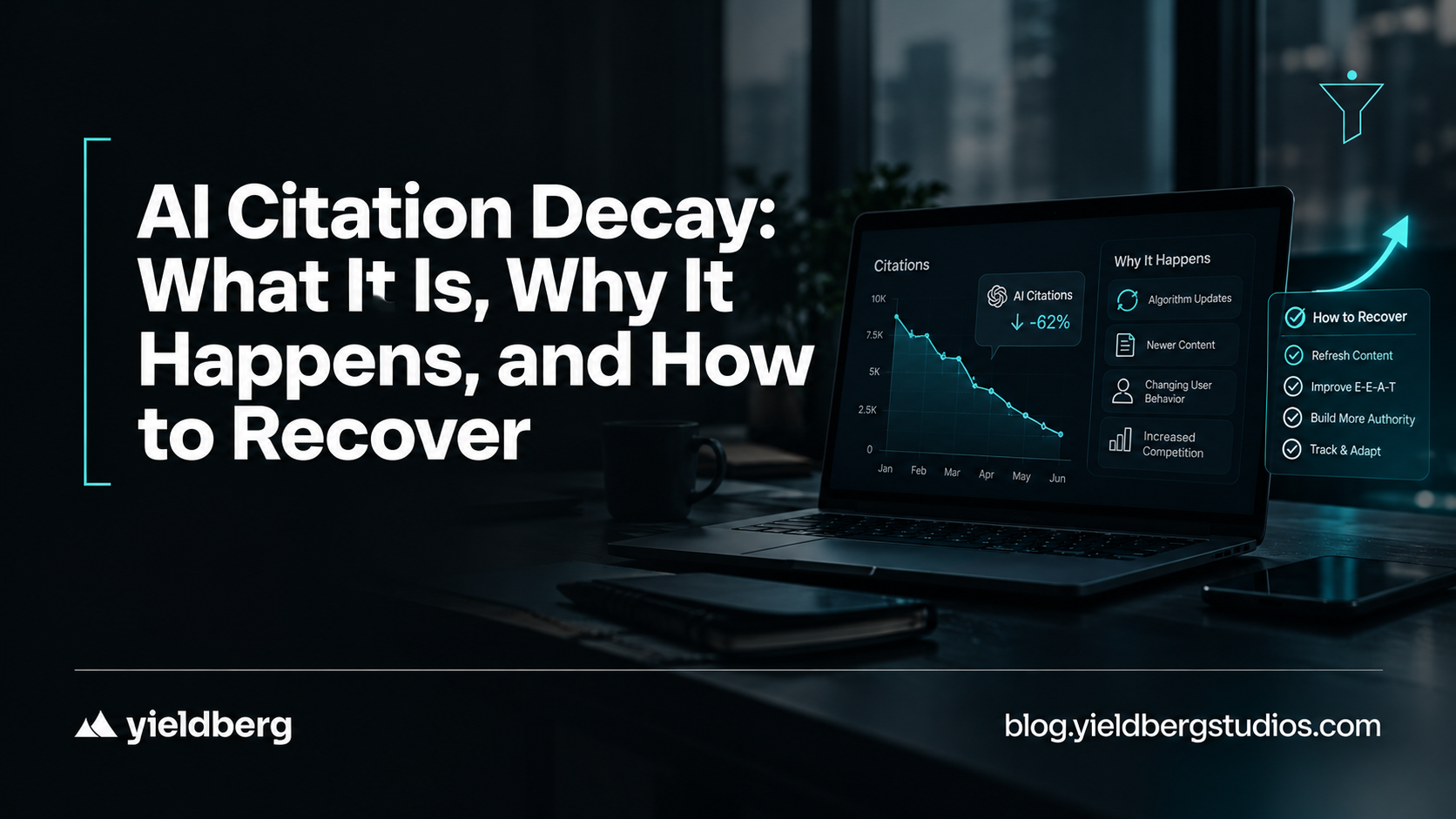
Six weeks ago, you checked a prompt your buyers use, and your brand was cited in the AI answer. This week you checked the same prompt, and a competitor is there instead. Your Google rankings haven't moved. Organic traffic looks normal. Search Console is quiet.
Nothing was deleted. No penalty was applied. Your content is exactly as good as it was.
This is AI citation decay, and it is easy to miss because none of your usual dashboards are built to show it. Here, we will explain it in plain terms: what it is, why it happens, how fast it moves, how to spot it early, and how to get your citations back.
AI Citation Decay
AI citation decay is the slow loss of your brand's presence in AI-generated answers, and it can happen without your content getting any worse.
It has three main causes: AI systems prefer fresher content, competitors keep publishing, and third-party coverage of your brand dries up. It also moves fast.
The median citation half-life is about 4.5 weeks, ChatGPT turns sources over fastest at about 3.4 weeks, and brands that keep earned media going hold citations for roughly 10 weeks, more than twice as long.
You will not see it in rankings or traffic, so you have to track citations directly. Recovery usually takes 6 to 12 weeks and needs both refreshed pages and new third-party coverage, because updating your own pages alone is not enough.
What is AI Citation Decay?
When someone asks ChatGPT, Perplexity, Gemini, or Google AI Mode a question, the answer is built from a pool of sources. Being "cited" means your brand or your page is one of the sources the answer draws on.
AI citation decay is what happens when your brand slowly drops out of that pool. You show up in fewer answers, then fewer again, until you are barely there.
Three things define it.
First, it is gradual. It is a trend over weeks, not a single event. Second, it is quiet, with no alert, penalty, or error message to warn you. Third, it has nothing to do with your content getting worse. You can lose ground simply by standing still while everything around you moves.
An easy way to picture it: imagine a shop on a busy street. The shop is unchanged, but new shops open nearby, the old signage fades, and the local guidebooks stop mentioning it. Nobody banned the shop. It just slowly stopped being the obvious answer to "where should I go?"
According to the AirOps 2026 State of AI Search report, only 30% of brands show up consistently when the same prompts are run back to back. The other 70% lose visibility between runs, and most do not know it.
Decay vs. Volatility: Two Different Things
These two terms get mixed up, and the difference matters because the fix is different.
Volatility is the normal behavior of a system that does not always give the same answer twice. You are in some answers and out of others, with no clear direction, and the right response is to keep monitoring. Decay is a downward trend. You appear less each time you check, across many prompts, and the right response is to step in with new content and earned media.
A quick test: take five prompts you care about and track your presence on them for four weeks. If you are in and out with no pattern, that is volatility. If you are showing up less each week across several of those prompts, that is decay.
Decay vs. a Ranking Drop
A ranking drop is an SEO problem. Decay usually is not.
A brand can hold the number one position on Google for every target keyword and still be missing from every AI answer in its category. SEO and GEO (generative engine optimization) are separate systems, measured differently and built on different signals.
Google weighs things like on-page relevance, backlinks, and engagement. Generative engines build answers from a constantly refreshed pool of sources, and they lean toward recent content, sources with topical authority, and content that several independent third parties reference.
So a brand that stops publishing, earns no new mentions, and builds no new citations does not necessarily lose a rank. It loses its place in the pool. That absence shows up in AI answers long before it shows up anywhere else.
The AirOps research makes the same point from another angle: roughly 60% of AI Overview citations come from pages that do not rank in the top 20 organic results. Ranking well and being cited are two separate achievements.
Why Your Analytics Will Not Catch It
Standard analytics measure clicks. Decay happens before the click.
Buyers now use ChatGPT, Perplexity, and Google AI Mode to compare vendors, build shortlists, and check their choices before they visit any website. If your brand is not cited in those answers, it is not on the shortlist, and you never find out.
You will not see a drop in rankings, a jump in bounce rate, or an odd line in Search Console. The demand that should have reached you went to someone else, and nothing in your reports records that.
Why AI Citation Decay Happens
There are three causes. None of them needs your content to get worse.
1. Source Recency Bias
AI retrieval systems favor newer material. A research paper on this tested seven major large language model rerankers, including GPT-4o, LLaMA-3, and Qwen-2.5, and found recency bias in all of them. Newer passages were consistently preferred over older ones.
The size of the effect is worth remembering: put two equally relevant passages side by side, give one a more recent date, and the model can change its preference up to 25% of the time. Larger models reduce the effect, but none remove it.
In practice, an article your team published eight months ago may lose to a weaker article published last week, simply because the newer one looks fresher.
2. Competitive Displacement
Even if your page never changes, the field around it does. AI engines keep updating which sources they draw from. When a competitor publishes a better-structured, more data-rich, or more recently updated page on a topic you used to own, you slide down relative to them.
You are not being punished. You are being outcompeted. This is why watching who is gaining citation share is often the quickest way to see where you are losing it.
3. Earned Media Drying Up
Part of what keeps you cited is that other websites keep referring to you. When your PR activity slows, new coverage stops, and fewer independent sources mention you, the AI system has less outside evidence to confirm what you say about yourself.
Your page has not changed. The rest of the web has simply stopped vouching for it.
How Fast Does AI Citation Decay Happen?
What "half-life" Means
Half-life is borrowed from science. It is the time it takes for half of something to disappear. Here, it is how long it takes for about half of a brand's citations to turn over.
A simple, made-up illustration: if a brand were cited 100 times today, a 4.5-week half-life means that around 50 of those citation spots would be gone or replaced about a month later. The number is only an example, but it shows why this is a maintenance problem rather than a one-time project.
What The Data Says
The key figures come from a joint study by Scrunch and Stacker. It tracked 3.5 million citation events across 120,000+ domains, 8 industries, and 6 AI platforms, from September 2025 to March 2026.
The median citation half-life is 4.5 weeks, so roughly half of a brand's citations turn over within about a month. Brands with active earned media distribution held their citations for about 10 weeks on average, more than double that.
In active B2B categories where competitors publish weekly, measurable citation drops typically appear within 4 to 6 weeks of stopping earned media activity.
Half-life by Platform
Each AI platform behaves differently.
| AI platform | Citation half-life | Suggested monitoring cadence |
| ChatGPT | 3.4 weeks | Weekly |
| Google AI Mode | 4.3 weeks | Weekly |
| Gemini | 4.6 weeks | Bi-weekly |
| AI Overviews | 4.7 weeks | Bi-weekly |
| Perplexity | 5.8 weeks | Bi-weekly |
Here is what this tells you.
ChatGPT turns over sources fastest, and a brand can lose its presence there in under a month. Perplexity holds citations the longest, and there both content quality and recency affect how long you stay cited.
Platforms can also move in opposite directions, so you can gain visibility on one engine while losing it on another at the same time.
That last point is the reason not to rely on one platform. Strong presence in Perplexity says nothing about what is happening in ChatGPT.
How to Detect AI Citation Decay
Why Checking by Hand Does Not Work
It is tempting to run a prompt, look at the answer, and decide whether you are still cited. The problem is that AI engines do not always give the same answer to the same question. One check tells you very little.
To separate real decay from normal fluctuation, you need to track your citation presence across many prompts and several time periods, using a tool built for it.
The Signal to Watch
Similarweb's AI Brand Visibility module includes a Citation Analysis tool built around a metric called the Domain Influence Score.
It measures how often a domain is cited across AI-generated answers for a tracked topic, as a percentage.
A domain cited in every answer scores 100%, and a domain cited in half of the answers scores 50%.
Tracked week over week, it shows when your presence starts to slip. Because campaigns cover ChatGPT, Google AI Mode, Gemini, and Perplexity in one place, you can also see which platform is slipping first, which matters given the different half-lives above.
The rule of thumb: if your Domain Influence Score trends down across two or three consecutive measurement windows, that is decay, not noise.
How to Set It Up
Open the AI Brand Visibility module and create a campaign for the topics you want to track. Then open the Citation Analysis tab, where your Domain Influence Score sits at the top.
It shows the share of AI answers, for your tracked topics, that cited your domain in the selected timeframe. Check it week over week and watch the direction, not any single reading.
How to Recover From AI Citation Decay
Recovery means fixing three things.
First, your own pages need to be fresher and more useful than what is being cited now. Second, you need coverage from the third-party sources AI engines already trust in your space. Third, your brand needs to be consistent across all of those sources.
Recovery typically takes 6 to 12 weeks after a publishing gap. The sooner you start, the shorter it is. Catching decay at week three means roughly a six-week fix. Catching it at week twelve can mean six months.
Step 1: Find the Prompts you Dropped Out of
Use Prompt Analysis to list every tracked query where your brand no longer appears in the cited sources. This is your recovery list.
Start with prompts that reflect active buyer research in your category, such as comparisons and "best for" questions. Those are the ones costing you the most.
Step 2: Refresh Your Pages with Real Updates
Changing the publish date or rewording a subheading will not do much. What helps is genuine new substance.
Add new data and updated statistics, bring in new examples, and write new sections that answer questions your original page did not cover.
For guidance on structuring pages so AI engines can find and use them, Similarweb has a separate guide on how to optimize content for LLMs.
Step 3: Go After the Sources AI Already Trusts
The Citation Analysis tab shows which third-party domains drive AI answers for your topics. These are not your competitors. They are the sites AI engines lean on when answering questions in your space, which makes them your clearest signal of where to invest.
In the Saucony example, the data pointed to a few clear places to invest.
In the Top Domains view, reddit.com was the largest by far, meaning it was cited more than any other source across Saucony's tracked topics in ChatGPT. REI.com and runningwarehouse.com came next, followed by runrepeat.com, runnersworld.com, and michiganfootdoctors.com.
In the Cited URLs table, grivetoutdoors.com's trail running shoe guide had the highest Influence Score at 2.41, followed by runningwarehouse.com's footwear guide at 1.99 and racedaylab.com's trail shoe guide at 1.75.
That gives the team a concrete action list: earn a presence in the Reddit threads that keep appearing, work toward placement in runningwarehouse.com and runnersworld.com content, and study what grivetoutdoors.com's trail guide covers that Saucony's own pages do not.
Step 4: Track Recovery
Check Citation Analysis weekly while you recover. Watch for the score to stop falling before you expect it to rise. That stabilization usually comes one to two weeks before real citation gains show up.
Substantive updates such as new data, examples, and new sections take one to two weeks to publish. Earned media takes longer, about two to four weeks to place and index, and the places to target are the top cited sources you find in Citation Analysis.
Brand consistency, meaning the same name, description, and positioning on every owned and third-party page, is ongoing work. So is monitoring, which comes down to a weekly check of your Domain Influence Score.
What Recovery Looks Like in Two Phases
In the first phase, stabilization, your citation presence stops falling. This usually happens within two to four weeks of publishing fresh content and earning new third-party coverage. In the second phase, recovery, citations start climbing back.
Brands that only refresh their own pages tend to stabilize but not fully recover.
The Most Common Mistake
Treating page updates as the whole fix. Refreshing content helps you re-enter the citation pool. But without new third-party coverage arriving at the same time, you will lose ground again just as fast.
How to Prevent Decay
AI citations are not set-and-forget. The brands that hold top citation positions do not necessarily have better content. They publish consistently, earn coverage regularly, and stay consistent across the web.
A practical routine, which is our suggestion built on the data above, looks like this.
Check your Domain Influence Score every week, and look at ChatGPT and Google AI Mode weekly since they turn over fastest. Review Gemini, AI Overviews, and Perplexity every two weeks.
Whenever you see a downward trend across two or three windows, pull the worst-hit prompts, check which domains replaced you, and start on page refreshes and earned media. Keep earned media going all the time, because the data shows active distribution roughly doubles how long citations last.
Frequently Asked Questions
How Do I Tell if it is Decay or Normal Fluctuation?
Do not rely on running one prompt and eyeballing the result, because AI engines do not always answer the same way twice. Fluctuation means you appear inconsistently, with no clear direction.
Decay means you show up less each time you check, across multiple prompts. A Domain Influence Score that falls across two or three consecutive measurement windows points to decay.
Can Decay Happen if my SEO Rankings are Strong?
Yes. Organic rankings and AI citations are independent signals. AI engines select sources based on freshness, how many independent third parties reference you, and topical authority, not on ranking position. Per AirOps, roughly 60% of AI Overview citations come from pages outside the top 20 organic results.
How Long Does Recovery Take?
Usually 6 to 12 weeks, depending on how long the gap was and how competitive your category is. Stabilization often comes within two to four weeks of fresh content and new coverage, and full recovery follows after that.
What is The Fastest Way to Start?
Identify the specific prompts you dropped out of, then check which domains are being cited there instead of you. That tells you exactly where to aim your earned media effort. Page updates alone will not be enough. New third-party coverage on the right sources is what moves the score.
What is the Difference Between Citation Decay and Citation Volatility?
Volatility is the normal back-and-forth of a dynamic system, where you are in some answers and out of others with no pattern. Decay is a downward trend across multiple prompts. Volatility calls for monitoring. Decay calls for a content and earned media response.
Related Searches:
- B2B vs. B2C AI Visibility: Why One Strategy Doesn't Fit Both
- Google Search Profiles: What They Are, Who Can Get One, and What SEOs Should Do About Them
- AI Visibility Scorecard Template: A Complete Measurement Framework